What Happens When the Jaw Coupling Spider Fails
November 3, 2025
Understanding Misalignment in Couplings Causes, Effects, and Solutions.
November 17, 2025 Dhaval Jani
on
Dhaval Jani
on
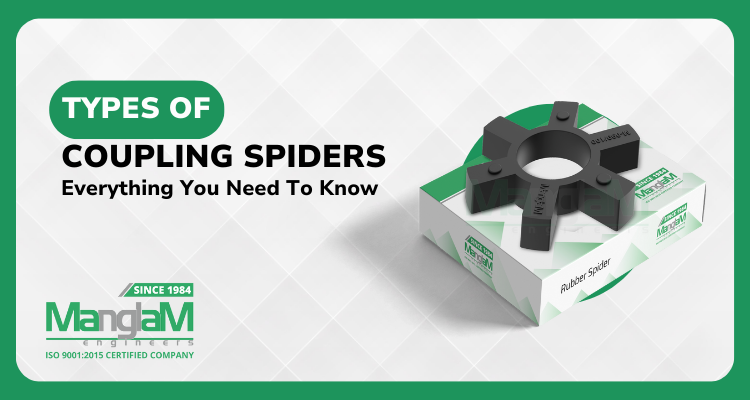
The main types of coupling spiders are defined by their material, which determines their torque, temperature, and vibration-damping capabilities. The most common materials are NBR (Buna-N/Rubber), Urethane (Polyurethane/PU), and Hytrel®.
Choosing the right coupling spider is essential. That inexpensive elastomer insert is the only component protecting your expensive motor and pump from a major metal-on-metal impact. Selecting the wrong material is the leading cause of premature failure, resulting in costly downtime and severe damage to shafts and bearings.
As a leading manufacturer of industrial couplings like Jaw Couplings and Normex Type Couplings, the team at Manglam Engineers helps MRO professionals and OEMs select the perfect elastomer insert every day.
This guide explains everything you need to know about coupling spider types, materials, and designs so you can make the right choice for your application.
What Is a Coupling Spider?
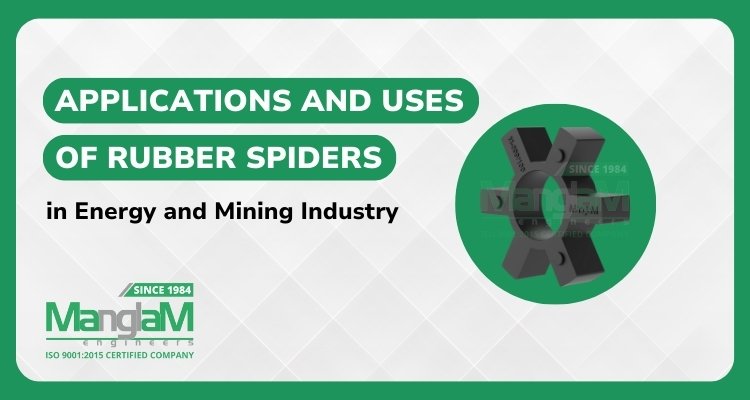
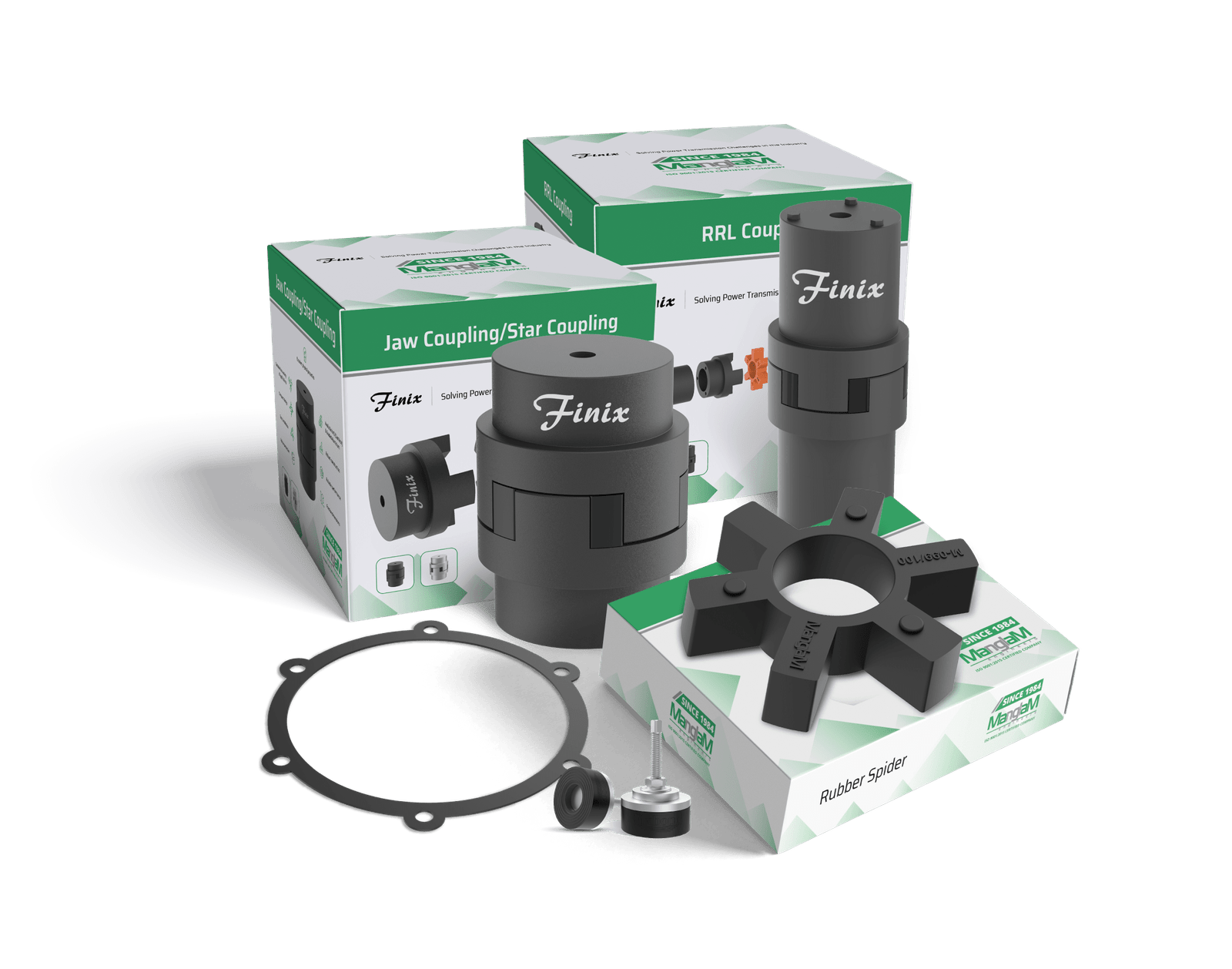
A coupling spider, also known as a jaw coupling, insert or elastomeric spider, is the flexible component that sits between the two metal hubs (or "jaws") of a jaw coupling.
Think of it as the "knee" in your power transmission system. It's not just a spacer; it's a mission-critical part.
What is Spider's Main Job?
The spider has four primary functions:
- Transmit Torque: It transfers rotational power from the driver's shaft (like a motor) to the driven shaft (like a pump).
- Dampen Vibration: It absorbs minor torsional vibration, protects sensitive components, and reduces operational noise.
- Absorb Shock Loads: It cushions the system against sudden jams, starts, or stops, acting like a small shock absorber.
- Allow for Misalignment: It provides a flexible bridge that compensates for small parallel, angular, and axial shaft misalignments.
Most importantly, it's a mechanical fuse. The spider is designed to be a sacrificial component. It fails first to prevent the metal jaws from colliding, protecting your expensive machinery from severe damage.
How Are Coupling Spiders Categorized?
When we talk about "types" of spiders, we are usually referring to two different things:
1. Material: What is it made of? This is the most important factor and dictates 90% of its performance.
2. Design (Shape): What is its physical shape? This determines which type of coupling hub fits (e.g., standard jaw, Rotex Type, or SW Type).
Let's explore the material types first, as this is where most selection mistakes are made.
The 3 Main Types of Coupling Spiders by Material
The material (and its hardness, or "durometer") determines everything.
1. NBR / Rubber Coupling Spiders
NBR (Nitrile Butadiene Rubber) is the most common and standard spider material, often black in color. It is a "true" rubber spider.
- Best For: General-purpose applications, especially those needing good vibration damping and shock absorption.
- Performance: It's the "softest" option, offering the best-in-class vibration damping. It has good oil and chemical resistance.
- Limitations: It has the lowest torque rating and the lowest operating temperature range (typically up to 212°F / 100°C). It can "shred" or disintegrate in high-torque applications.
2. Urethane / Polyurethane (PU) Coupling Spiders
Urethane (or PU) is a step-up from NBR and is one of the most versatile polyurethane coupling spider types. It's often yellow or red, though color varies by manufacturer.
- Best For: Applications need higher torque, better chemical/oil resistance, and more durability than NBR.
- Performance: Urethane offers great balance. It can handle about 1.5 times the torque of NBR and has a broader temperature range. It's tougher and more wear resistant.
- Limitations: It is stiffer than NBR, so it does not dampen vibration effectively.
3. Hytrel® Coupling Spiders
Hytrel is a high-performance thermoplastic polyester. This is the "high torque" or "high temp" option, often seen in green, white, or red.
- Best For: High-torque, high-speed, and high-temperature applications like motor-to-gearox power transmission.
- Performance: Hytrel® can handle significantly more torque (up to 3 times NBR) and high temperatures (up to 300°F / 150°C).
- Limitations: It is very rigid and offers almost zero vibration damping. This rigidity makes it brittle, so it can crack or shatter under sudden, extreme shock loads.
Comparison: NBR vs. Urethane vs. Hytrel Spiders
This table provides a simple breakdown for MRO (Maintenance, Repair, & Overhaul) and OEM (Original Equipment Manufacturer) decision-making.
| Feature | NBR (Buna-N) | Urethane (PU) | Hytrel® |
|---|---|---|---|
| Common Color | Black | Yellow / Red | Green / White / Red |
| Typical Hardness | ~80 Shore A | ~90-95 Shore A | ~55-64 Shore D |
| Torque Capacity | Good (Standard) | Better (High) | Best (Very High) |
| Vibration Damping | Excellent | Good | Poor / None |
| Shock Absorption | Excellent | Good | Poor (can be brittle) |
| Temp. Range | Good (up to 212°F / 100°C) | Better (up to 250°F / 121°C) | Best (up to 300°F / 150°C) |
| Best For... | Standard pumps, fans, conveyors (vibration-heavy systems) | General-purpose, high-torque, chemical/oil environments | High-torque, high-speed, high-temp (gearboxes, servos) |
Common Coupling Spider Types by Design (Shape)
While the material is key, the shape of the spider must match the design of your coupling hubs.
Standard Jaw Coupling Spiders (L-Type)
This is the most common design, often called an "L-Type" or "C-Type" spider. It's a single, solid "star-shaped" piece that fits between two interlocking jaws. These are the spiders used in most standard Jaw Coupling applications.
Rotex / Normex Type Spiders
This design looks more like a flower or gear. It's used in Normex Type Couplings (and Rotex Type Couplings).
- How it Works:The spider's "petals" are slightly larger than the gaps in the hubs. When installed, this creates a "pre-compressed" state.
- The Benefit: This pre-compression eliminates any "backlash" or "play" in the coupling, making it excellent for applications with frequent starts/stops and precision equipment. We manufacture high-quality Normex Type Spiders specifically for this purpose.
SW Type Spiders (Split Spiders)
Used in SW Couplings, this spider is unique because it's split into two pieces (or has a "wrap-around" design).
- How it Works: The spider can be installed or replaced without moving the motor or the pump. You just "wrap" the insert around the coupling and secure it.
- The Benefit: This is purely for maintenance. It's a massive time-saver for MRO teams, as it turns a multi-hour replacement job (requiring re-alignment) into a 15-minute task. Our SW Type Spider is a popular choice for hard-to-reach equipment.
How Do I Choose the Right Coupling Spider?
Choosing the wrong spider is the fastest way to cause a breakdown. Ask these 4 questions to find the right one for your industrial coupling spider needs.
1. What is the application?
A high-vibration pump needs a different spider than a high-torque gearbox.
- Pumps, Fans, Blowers: Start with NBR. Its superior damping protects the system from vibration.
- Gearboxes, Servo Motors: Start with Hytrel®. It can handle high torque and speed, and precision systems don't want the "springiness" of NBR.
- General Purpose/Mix: Urethane is your best all-around bet.
2. What is the environment (temp, chemicals)?
Look at what's in the air or what might drip on the coupling.
- High Heat (> 212°F): You must use Urethane or Hytrel®. NBR will melt or become brittle.
- Oils & Chemicals: NBR and Urethane are both excellent. Check out a chemical compatibility chart if you're dealing with aggressive solvents.
3. What is torque and horsepower?
Check the specs of your motor. A more powerful motor requires a higher-torque material. If your NBR spiders are "shredding" or "dusting," you have a torque (or misalignment) problem. Upgrading to Urethane is a common solution.
4. How much vibration or shock?
This is the most critical question.
- High Shock Load (e.g., a rock crusher, a conveyor):NBR is the best shock absorber. Hytrel® is the worst and may shatter.
- High Vibration (e.g., a large piston pump): NBR is the best. Using a rigid Hytrel® spider here will transfer that vibration directly to the motor bearings, destroying them.
The Right Spider, The Right Partner
That small elastomeric coupling spider is more than just a piece of rubber; it's the critical link that ensures the reliability and longevity of your entire equipment to train. Choosing the right material—NBR for damping, Urethane for balance, or Hytrel® for torque—is a simple decision that prevents thousands in downtime.
At Manglam Engineers, we specialize in providing the exact power transmission components you need to keep your operations running. From a single Rubber Spider replacement to a full shipment of Jaw Couplings, we have the technical expertise to support your needs.
Ready to Improve Your Reliability?
- Need help diagnosing a failure?Our technical team can help you select the correct spider material for your specific pump, gearbox, or industrial application.
- Browse our full catalog: of power transmission products, including Normex Type Spiders, SW Type Spiders, and complete coupling assemblies.
- Request a quote today for your MRO inventory and ensure you have the right parts on hand before you need them.
Frequently Asked Questions (FAQ)
- Black: NBR (Buna-N)
- Yellow/Red: Urethane (PU)
- Green/White: Hytrel®
- Softer (e.g., 80A NBR): Better vibration/shock absorption, lower torque.
- Harder (e.g., 60D Hytrel®): Higher torque capacity, almost no vibration absorption.
- Cracks or missing legs.
- "Dust" (black, red, or yellow powder) inside the guard.
- A "gummy" or melted appearance.
- An increase in system vibration or noise.

Dhaval Jani
Managing Director at Manglam Engineers
Dhaval Jani is the Managing Director of Manglam Engineers , a trusted manufacturer of transmission couplings and rubber parts. With a background in mechanical engineering and extensive industry experience, he leads the company’s focus on product innovation, manufacturing excellence, and global business growth.