Jaw Coupling Selection Checklist for Pumps Industries
March 11, 2026
Jaw Couplings for Mining Equipment in African Industries
April 10, 2026 Dhaval Jani
on
Dhaval Jani
on

Dhaval Jani
Managing Director at Manglam Engineers
Dhaval Jani is the Managing Director of Manglam Engineers , a trusted manufacturer of transmission couplings and rubber parts. With a background in mechanical engineering and extensive industry experience, he leads the company’s focus on product innovation, manufacturing excellence, and global business growth.
Southeast Asia is in the middle of a massive infrastructure and industrial boom. From cement mega-plants in Vietnam and Indonesia to open-pit mines in the Philippines and Malaysia, the demand for reliable, high-performance mechanical components has never been higher.
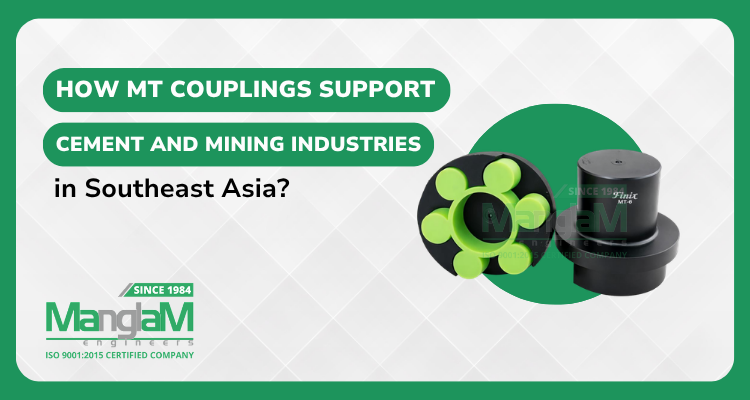
At the centre of this power transmission challenge is one component that consistently delivers: the MT Coupling. MT Couplings short for Metal Tyre Couplings are purpose-built flexible shaft couplings designed to handle extreme torque loads, misalignment, and shock demands of heavy industrial applications.
For cement plants, MT couplings keep rotary kilns, ball mills, and conveyor drives running without interruption. For mining operations, they absorb brutal shock loads from crushers, conveyors, and excavators protecting expensive drivetrain components and slashing downtime. Manglam Engineers (manglamengineers.com) supplies MT couplings and a full range of industrial couplings engineered for exactly these conditions.
Key Takeaways
- MT Couplings are flexible metal tyre couplings that handle high torque, misalignment, and shock loads in heavy industries
- Southeast Asia’s cement and mining sectors are among the highest-demand markets for MT couplings globally
- MT couplings are used in rotary kilns, ball mills, crushers, conveyors, and other critical heavy equipment
- They outperform rigid couplings in shock absorption and misalignment tolerance — directly reducing unplanned downtime
- Manglam Engineers supplies MT couplings and complementary types (Jaw, HRC, Gear, Chain, Tyre) for complete drivetrain coverage
- Selecting the right coupling requires matching torque rating, bore size, misalignment tolerance, and environmental conditions
What Is an MT Coupling and How Does It Work?
An MT Coupling (Metal Tyre Coupling) is a flexible shaft coupling that uses a metallic tyre element typically made from a specially formulated elastomeric compound to transmit torque between two shafts. Unlike rigid couplings, the flexible element absorbs vibration, handles angular and parallel misalignment, and cushions shock loads before they damage connected equipment.
Core components of an MT Coupling:
- Two flanged hubs (driver and driven side)
- A metallic or elastomeric tyre element bolted between the hubs
- High-strength fasteners rated for dynamic torque loads
- Optional spacer variants for maintenance without moving shafts
The tyre element is the heart of the coupling. It deflects under load to absorb misalignment and shocks, then returns to its original shape providing a self-dampening, maintenance-friendly connection between rotating shafts.
Think of it like the tyre on a heavy truck: it flexes to absorb road shocks, but never loses its load-carrying capacity. MT couplings work on the same principle but for rotating machinery in the harshest industrial environments on earth.
Why Do Cement and Mining Industries in Southeast Asia Need MT Couplings?
Southeast Asia’s industrial landscape presents a unique set of mechanical challenges. High ambient temperatures, humidity, dust, abrasive particulate matter, and extreme operating cycles put conventional couplings under severe stress. MT couplings are engineered to meet these exact conditions.
Challenges in Cement Manufacturing that MT Couplings solve:
- Rotary kilns operate continuously at high temperatures rigid couplings fail under thermal expansion and misalignment
- Ball mills generate extreme cyclic torque loads that snap rigid shaft connections
- Conveyor drives must manage variable loads without transmitting vibration to the gearbox
- Startup loads in cement equipment are often 3–5x the rated running torque
Challenges in Mining Operations that MT Couplings address:
- Jaw crushers and cone crushers produce violent shock loads every few seconds
- Mining conveyors carry massive loads over long distances any vibration causes rapid bearing wear
- Excavators and draglines require couplings that handle sudden load reversals
- Underground mining environments demand zero-maintenance, sealed coupling designs
MT couplings handle all of these challenges by design. Their flexible tyre element absorbs shocks before they reach the gearbox, motor, or bearings protecting the most expensive components in the drivetrain.
Where Are MT Couplings Used in Cement Plants?
Cement manufacturing is one of the most mechanically demanding industries in the world. The process involves continuous high-temperature grinding, blending, and conveying all requiring reliable, high-torque shaft couplings.
Key cement plant applications for MT Couplings:
- Rotary Kiln Drives – Main and auxiliary drive connections requiring high torque and angular misalignment tolerance
- Ball Mill Drives – High cyclic load variation where shock absorption is critical
- Raw Mill Drives – Vertical and horizontal mill configurations with heavy shaft loads
- Cement Conveyor Drives – Long-distance belt conveyors with variable load profiles
- Clinker Cooler Fan Drives – High-speed fan shafts requiring precision balance and low vibration
- Bucket Elevator Drives – High starting torque applications with vertical load requirements
In cement plants, an unplanned shutdown of a kiln or ball mill can cost tens of thousands of dollars per hour in lost production. MT couplings by absorbing misalignment and shock are among the most cost-effective insurance policies a plant engineer can invest in.
How Do MT Couplings Perform in Mining Machinery?
Mining is arguably the most demanding operating environment for any mechanical component. Shock loads, contamination, temperature extremes, and 24/7 operation mean that only the most durable couplings survive long-term.
Critical mining applications where MT Couplings excel:
- Jaw Crushers & Cone Crushers – Absorbs violent shock loads generated at every crushing cycle
- Mine Conveyors – Protects gearboxes from overload on steep-grade belt conveyors
- Ball Mills & SAG Mills – Handles high cyclic torque in ore grinding circuits
- Draglines & Excavators – Manages sudden torque reversals in swing and hoist drives
- Pump Drives – Maintains alignment under high-pressure slurry pumping conditions
- Centrifugal Fans – Maintains balance and reduces vibration in mine ventilation systems
Industry data shows that misalignment and vibration account for over 50% of premature bearing failures in mining equipment. MT couplings directly address this by accommodating up to 1.5° of angular misalignment and significant parallel offset without transmitting bending moments to connected shafts.
MT Couplings vs. Other Industrial Couplings: How Do They Compare?
Choosing the right coupling depends on torque requirements, misalignment tolerance, shock load capacity, and maintenance needs. Here is how MT couplings compare to common alternatives for cement and mining applications:
|
Coupling Type |
Shock Absorption |
Misalignment Tolerance |
Maintenance Needs |
Best For |
|
MT Coupling |
Excellent |
High (Angular + Parallel) |
Low |
Crushers, Mills, Kilns |
|
HRC Coupling |
Good |
Moderate |
Low |
Pumps, Fans, Compressors |
|
Jaw Coupling |
Moderate |
Moderate |
Low |
Light-Medium Drives |
|
Gear Coupling |
Low |
Low |
High (Lubrication) |
High-Speed, High-Torque |
|
Moderate |
Moderate |
Moderate |
Conveyors, General Use | |
|
Tyre Coupling |
Excellent |
Very High |
Very Low |
High-Shock Applications |
|
Pin Bush Coupling |
Moderate |
Moderate |
Low |
Direct-Coupled Drives |
For the most severe applications- jaw crushers, ball mills, and rotary kiln drives MT couplings and Tyre couplings consistently outperform alternatives due to their superior shock absorption and misalignment accommodation.
Which Southeast Asian Countries Have the Highest Demand for MT Couplings?
Southeast Asia’s industrial output is growing rapidly, driving significant demand for heavy-duty power transmission components across the region.
Indonesia is one of the world’s largest cement producers and a major mining nation (nickel, coal, copper). Expanding infrastructure projects- roads, ports, power plants are creating sustained demand for MT couplings in both sectors.
Vietnam’s cement industry has grown dramatically over the past decade, now ranking among the top 5 globally by output. Multiple large-scale cement plants in Vietnam’s southern industrial corridors specify MT couplings for kiln and mill drives as standard.
The Philippines is a significant nickel and copper producer. Mining operations in Mindanao and Luzon require heavy-duty couplings for crusher and conveyor applications in challenging tropical environments.
Malaysia and Thailand both have significant quarrying, aggregate processing, and cement manufacturing sectors. Industrial buyers in these markets increasingly prefer sourcing from trusted Indian engineering suppliers due to quality, pricing, and lead time advantages.
Looking for MT Couplings for Your Project in Southeast Asia?
Manglam Engineers supplies MT Couplings, Tyre Couplings, HRC Couplings, Gear Couplings, and more engineered for cement and mining applications. Visit manglamengineers.com to explore the full product range or request a technical consultation.
What Are the Key Technical Advantages of MT Couplings for Heavy Industry?
MT couplings deliver a combination of technical features that make them uniquely suited to the demands of cement and mining operations:
1. High Torque Transmission Capacity MT couplings are available across a wide range of torque ratings from small auxiliary drives to main kiln drives requiring thousands of Newton-metres of continuous torque. This scalability makes them the preferred choice for engineers designing across multiple equipment sizes.
2. Shock Load and Vibration Damping The tyre element acts as a natural damper. In crusher applications, where shock loads can spike to 300–400% of rated torque, the MT coupling absorbs the energy before it reaches the gearbox dramatically extending gearbox and motor service life.
3. Misalignment Tolerance MT couplings accommodate angular misalignment (up to 1.5°), parallel offset, and axial movement simultaneously. This is critical in large installations where thermal expansion causes shaft drift during operation.
4. Maintenance-Friendly Design Many MT coupling variants allow tyre replacement without moving connected shafts or drives. In a cement plant or mine, this means maintenance can be completed in hours rather than days minimising production loss.
5. Long Service Life in Harsh Environments MT coupling tyre elements resist oil, grease, dust, and moderate chemical exposure. In mining environments with abrasive particulate matter and moisture, they significantly outlast rubber-only flexible elements.
How to Select the Right MT Coupling for Cement and Mining Equipment?
Selecting the correct MT coupling specification is critical. An undersized coupling will fail prematurely; an oversized one adds unnecessary weight and cost. Here is a structured selection approach:
Step 1: Define the Torque Requirement
- Calculate nominal torque: T = (Power in kW × 9,550) / RPM
- Apply a service factor based on the application (crushers: 2.5–3.0; conveyors: 1.5–2.0; mills: 2.0–2.5)
- Design torque = Nominal Torque × Service Factor
Step 2: Identify Shaft Sizes and Bore Requirements
- Measure driver and driven shaft diameters
- Confirm keyway dimensions and tolerance requirements
- Check whether a spacer coupling is required for maintenance access
Step 3: Assess Misalignment Conditions
- Measure or estimate angular misalignment between shafts
- Assess parallel offset under operating thermal conditions
- Confirm whether axial float is expected during operation
Step 4: Consider Environmental Factors
- Operating temperature range (standard tyre elements: -30°C to +100°C)
- Exposure to chemicals, oils, or abrasives
- Outdoor vs. enclosed installation conditions
Manglam Engineers’ technical team assists OEMs, EPC contractors, and maintenance engineers with coupling selection providing datasheets, load calculations, and dimensional drawings for any application.
What Other Couplings Does Manglam Engineers Offer for Heavy Industry?
While MT couplings are the primary choice for the most demanding applications, Manglam Engineers supplies a comprehensive range to cover every point in a cement or mining plant’s drivetrain:
|
Coupling Type |
Key Strength |
Typical Application |
|
MT Coupling |
High shock absorption, high misalignment |
Kilns, Ball Mills, Crushers |
|
Tyre Coupling |
Maximum flexibility, zero backlash |
High-shock crusher drives |
|
HRC Coupling |
Compact, robust, easy replacement |
Pump drives, fans, blowers |
|
Jaw Coupling |
Simple, cost-effective |
Small auxiliary drives |
|
Gear Coupling |
Very high torque, compact |
High-speed main drives |
|
Chain Coupling |
High load capacity |
General conveyor drives |
|
Rotex Type |
Low backlash, vibration damping |
Precision servo drives |
|
Nylon Gear Coupling |
Lubrication-free, lightweight |
Light industrial drives |
|
Pin Bush Coupling |
Easy replacement, affordable |
General industrial drives |
|
Normex Type |
High torque, heat resistant |
High-temperature applications |
|
Flexible, compact |
Pump and motor connections | |
|
GR Coupling |
High torque, flexible |
General power transmission |
|
Simple, reliable |
Low to medium torque drives |
Having a single, reliable supplier for multiple coupling types simplifies procurement, ensures dimensional compatibility, and streamlines spare parts management — a significant advantage for plants managing dozens of drive systems.
How Do MT Couplings Reduce Total Cost of Ownership in Cement and Mining?
The initial cost of an MT coupling is only a fraction of its total value to a plant operation. The real ROI comes from what it prevents:
- Reduced gearbox failures – Shock absorption prevents gear tooth fracture; gearbox replacements cost $50,000–$500,000 depending on size
- Extended bearing life – By accommodating misalignment, MT couplings reduce radial loads on bearings a primary cause of premature failure
- Lower maintenance downtime – Tyre replacement without shaft movement takes hours, not days, reducing production loss significantly
- Protected motor windings – Vibration and shock transmitted through rigid couplings cause premature motor winding failure; MT couplings eliminate this
- Reduced structural fatigue – Shock load transmission causes fatigue cracks in frames and foundations over time; flexible couplings break the transmission path
In a typical cement plant ball mill installation, switching from a rigid coupling to an MT coupling can extend gearbox overhaul intervals by 2-3x delivering a payback period measured in months, not years.
What Are the Installation Best Practices for MT Couplings?
Even the best coupling will underperform or fail early if installed incorrectly. The most important installation guidelines for MT couplings in cement and mining applications:
- Shaft Alignment First – Always align shafts to within the coupling’s rated misalignment tolerance before installation; the coupling compensates for operational drift, not installation errors
- Correct Hub Fit – Use the manufacturer’s recommended bore tolerance (typically H7 fit) and keyway dimensions; a loose hub causes fretting and rapid failure
- Fastener Torque – Apply specified bolt torque to the tyre element flange bolts; under-torquing leads to slip, over-torquing damages the tyre
- Guard Installation – Always fit a coupling guard not just for safety, but to prevent contamination of the tyre element with abrasive dust
- Periodic Inspection – Check tyre condition at planned maintenance intervals; look for cracking, hardening, or uneven wear as early warning signs
What Are the Emerging Trends in Industrial Couplings for Southeast Asian Markets?
1. Increased Demand for Maintenance-Free Designs With skilled maintenance technicians in short supply across Southeast Asian markets, plant operators are increasingly specifying couplings that require zero lubrication and minimal scheduled maintenance. MT couplings align perfectly with this trend.
2. Growth in Modular Equipment Design EPC contractors designing modular cement and processing plants require couplings with flexible shaft engagement that accommodate field alignment tolerances. MT couplings are increasingly specified in pre-engineered package units.
3. Focus on Energy Efficiency Power transmission losses in flexible couplings are a growing concern. MT couplings, when properly specified, operate at over 98% power transmission efficiency contributing to plant energy targets.
4. Supplier Consolidation Procurement teams in large cement groups and mining conglomerates are consolidating coupling suppliers to reduce complexity. Manglam Engineers’ comprehensive range from small jaw couplings to heavy-duty MT and Gear couplings positions them as a preferred single-source supplier for these buyers.
Why Manglam Engineers Is the Right Partner for MT Couplings in Southeast Asia
Industrial buyers across Southeast Asia face a common challenge: sourcing high-quality, precisely engineered couplings from suppliers who understand the demands of cement manufacturing and mining operations.
Manglam Engineers brings decades of engineering expertise in mechanical power transmission, supplying MT couplings, Tyre couplings, HRC couplings, Gear couplings, Jaw couplings, and the full range of industrial coupling types to OEMs, EPC contractors, and infrastructure firms across India and international markets.
Every coupling is manufactured to tight dimensional tolerances, tested for torque capacity, and supplied with full technical documentation making specification, installation, and maintenance straightforward for engineering teams.
Whether you are commissioning a new cement plant in Vietnam, upgrading conveyor drives in a Philippine mine, or sourcing replacement couplings for a Malaysian industrial facility. Manglam Engineers has the product, the technical expertise, and the supply capability to support your project.
Ready to Specify MT Couplings for Your Cement or Mining Project?
Explore Manglam Engineers’ full coupling range at manglamengineers.com. Request a technical datasheet, dimensional drawing, or project quotation. Contact our engineering team for application-specific recommendations.
Frequently Asked Questions (FAQ)
Q1: What is an MT Coupling and how is it different from other flexible couplings?
An MT Coupling (Metal Tyre Coupling) uses a metallic tyre element mounted between two flanged hubs to transmit torque. Unlike rubber jaw couplings or HRC couplings, MT couplings handle significantly higher shock loads, greater misalignment, and more severe operating environments making them the preferred choice for cement kilns, ball mills, and mining crushers.
Q2: Can MT Couplings handle misalignment in heavy equipment like ball mills and crushers?
Yes. MT couplings are specifically designed to handle angular misalignment (up to 1.5°) and parallel offset simultaneously during operation. This makes them ideal for large rotating equipment where shaft alignment drifts due to thermal expansion, structural settling, or operational vibration.
Q3: How do I select the right MT Coupling size for my cement plant or mining equipment?
Coupling selection requires three key inputs: the design torque (nominal torque × service factor for the application), shaft bore sizes on both sides, and operating environment conditions. For complex applications, Manglam Engineers’ technical team can assist with selection, providing dimensional drawings and load calculations.
Q4: What is the typical service life of an MT Coupling in a mining or cement application?
In well-maintained cement plant applications, MT coupling tyre elements typically last 3–7 years before replacement. In high-shock mining applications such as jaw crushers, inspection intervals of 12–18 months are recommended, with replacement based on tyre condition looking for cracking, hardening, or uneven wear.
Q5: Does Manglam Engineers supply MT Couplings for export to Southeast Asian markets?
Yes. Manglam Engineers supplies MT couplings and a comprehensive range of industrial couplings to international buyers including OEMs, EPC contractors, and industrial distributors in Southeast Asia. Export documentation, packaging standards, and competitive pricing for international orders are all supported. Visit manglamengineers.com or contact the team directly for export enquiries.