
Understanding Misalignment in Couplings Causes, Effects, and Solutions.
November 17, 2025
Choosing the Right Coupling for Motors and Gearboxes
December 3, 2025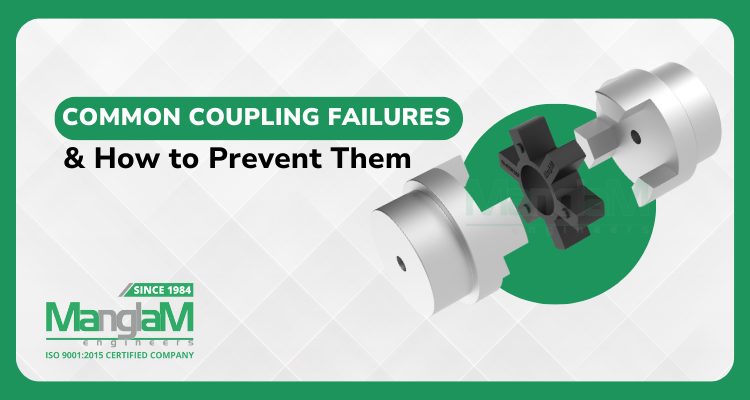
Your power transmission system is only as strong as its weakest link. Often, that link is coupling.
When a coupling fails, it rarely happens quietly. It results in unplanned downtime, damaged shafts, broken gears, and expensive production halts. For industries like manufacturing, oil and gas, and automotive, these interruptions are unacceptable.
At Manglam Engineers, we understand that keeping your machinery running requires more than just buying parts—it requires understanding why they fail. This guide covers the most common coupling failures, signs of wear, and actionable maintenance tips to extend the life of your equipment.
What Causes Most Coupling Failures?
The top 4 causes of coupling failure are:
- Misalignment: The shaft centers do not align properly (responsible for over 50% of failures).
- Improper Lubrication: Critical for metallic couplings like gear or chain types.
- Incorrect Selection: Using a coupling that cannot handle the torque or speed of the application.
- Environmental Stress: Heat, chemicals, or grit degrading rubber components like spiders or tyres.
By fixing these four areas, you can drastically improve industrial machinery reliability.
1. Misalignment:
What is coupling misalignment?
Misalignment occurs when the driver's shaft (e.g., motor) and the driven shaft (e.g., pump) are not on the same centerline. While flexible couplings are designed to handle some misalignment, exceeding the manufacturer's limits leads to rapid destruction.
Types of Misalignments:
- Parallel Misalignment: Shafts are parallel but offset.
- Angular Misalignment: Shafts are at an angle to each other.
- Axial Misalignment: The distance between shaft ends is incorrect (too close or too far).
Fix: Use laser alignment tools or dial indicators during installation. If your system is open to shifting, switch to high-tolerance flexible couplings like the Tyre Coupling or RRL Coupling offered by Manglam Engineers, which accommodate higher degrees of misalignment.
2. Component Wear: Spiders, Tyres, and Bushes
Flexible couplings often use a rubber or elastomeric element to transmit torque. Over time, these consumable parts are worn out. This is actually a good thing; they are designed to fail before your expensive motor or pump does.
Jaw and Spider Coupling Failures
Jaw Couplings depend on a Rubber Spider (or elastomer) placed between metal hubs.
The Problem: If the spider turns to powder or looks melted, the coupling was likely overheating or subjected to excessive vibration.
The Solution: Regularly inspect the spider. If you see what to wear, replace it immediately. We offer durable Normex Type Spiders, Rotex Type Spiders, and SW Type Spiders designed for high-stress environments.
Pin Bush and HRC Failures
Pin Bush Type Couplings and HRC Type Couplings use rubber bushes to reduce vibration.
The Problem: The rubber hardens and cracks over time, leading to metal-on-metal contact.
The Solution: Squeeze the rubber elements during inspection. If they feel solid or brittle, it is time for a replacement set of Rubber Bushes or Rubber T-Cushions.
3. Lubrication Failure (Metallic Couplings)
Not all couplings are "installed and forgotten." Metallic couplings, specifically Gear Couplings and Chain Couplings, require grease to function.
Why it happens: Seal Failure: The Rubber O-Ring or gasket fails, allowing grease to leak out (and dirt to get in).
Centrifugal Force: High speeds separate the oil from the thickener in the grease, leaving the metal dry.
Prevention: Check the Rubber Gaskets and seals regularly. If you are in an industry where maintenance is difficult (like enclosed HVAC or mining equipment), consider switching to a non-lubricated option like a Nylon Gear Coupling or a Jaw Coupling.
Signs of Coupling Failure: What to Listen and Look For
How do you know a coupling is about to break? Your machine will usually tell you. Here is a coupling inspection checklist:
- Abnormal Noise: A screeching, clanking, or rattling sound often indicates metal-on-metal contact (meaning the rubber element is gone).
- Excessive Vibration: If the machine is shaking more than usual, check for shaft coupling misalignment or a loose set screw.
- Wobble: Visually inspect the coupling while it rotates (using a strobe light). If it wobbles, the bore may be worn.
- Debris: Finding rubber dust (from a Rubber Spider or Tyre) on the floor below the coupling is a clear sign of wear.
Comparison: Failure Symptoms vs. Solutions
Use this table to quickly fix your industrial coupling problems.
| Symptom | Probable Cause | Recommended Action | Suggested Product |
|---|---|---|---|
| Rubber dust around guard | Spider/Insert wear due to misalignment | Re-align shafts; replace insert | Normex/Rotex Type Spider |
| Loud clanking noise | Elastomer failure; metal-on-metal contact | Immediate shutdown; replace coupling | HRC Type Coupling |
| Premature grease loss | Seal failure or O-Ring damage | Replace seals and gaskets | Rubber O-Ring / Gasket |
| Severe Vibration | Loose bolts or damaged mount | Check mounting; replace rubber mounts | Anti-Vibration Rubber Mounts |
| Torn flexible element | Shock load / Torque overload | Upgrade to higher torque rating | Tyre Coupling / RRS Coupling |
How to Prevent Coupling Failures (Best Practices)
Preventive maintenance is always cheaper than reactive repair. Here is how to extend coupling life.
1. Select the Right Coupling for the Job
Don't just replace "like for like" if the previous one fails quickly.
- High vibration? Use a Tyre Coupling.
- High torque? Use a Pin Bush or Gear Coupling.
- Simple motor pump? Jaw Coupling or RRS Coupling is usually sufficient.
Need help selecting? Contact Manglam Engineers for a consultation.
2. Follow Proper Installation Protocols
Never push a coupling hub onto a shaft. This damages the bearings and coupling. Use heat induction or proper fitting tools. Ensure the gap between shafts (DBSE) matches the manufacturer's specifications.
3. Routine Inspection Schedule
- Weekly: Listen for noise and check for vibration.
- Monthly: Visually inspect for leaks (gear couplings) or rubber dust (jaw/tyre couplings).
- Annually: Shut down, remove the guard, and inspect Glass Ring Rubbers, bushes, and alignment.
Why Choose Manglam Engineers?
At Manglam Engineers, we don’t just supply parts; we provide solutions for Power Transmission Products. Whether you are in the Pulp and Paper industry, pharmaceutical sector, or manufacturing Agricultural Equipment, we have the inventory to keep your moving.
From SW Couplings to MT Couplings and every Rubber Bush in between, our products are engineered for durability and precision.
Ready to Improve Your Machinery Reliability?
Don't wait for a breakdown to think about your couplings. Ensure your plant operates at peak efficiency with high-quality couplings and rubber spares.
[Explore Our Full Range of Couplings] [Contact Manglam Engineers for a Quote]