
How MT Couplings Support Cement and Mining Industries in Southeast Asia?
April 9, 2026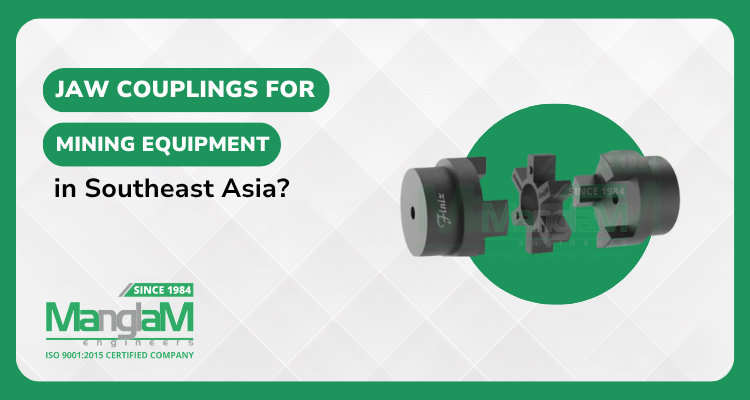
Africa’s mining industry is one of the most demanding operating environments on the planet. From the deep-level gold mines of South Africa and the copper belt of Zambia to the iron ore operations of Guinea and the coal fields of Mozambique, mining equipment faces extreme shock loads, abrasive dust, temperature swings, and continuous high-torque demands all at once.
In this environment, a single component failure in the power transmission chain can halt an entire production line. That’s why engineering and procurement teams across the continent are increasingly specifying industrial jaw couplings as the go-to flexible coupling for critical mining drives.
At Manglam Engineers, we manufacture and supply a full range of jaw couplings and power transmission couplings engineered for exactly these conditions backed by precise bore and keyway specifications, a range of spider insert hardness options, and reliable global supply.
Key Takeaways
- Jaw couplings are the preferred flexible coupling for African mining operations due to their shock absorption, misalignment tolerance, and fail-safe design.
- Polyurethane spider inserts with 92-98 Shore A hardness are recommended for heavy-duty applications involving grinding mills and vibrating screens.
- The replaceable spider element allows maintenance without shaft disassembly critical for reducing downtime in underground mining.
- Angular misalignment compensation of up to 1° makes jaw couplings ideal for the shaft alignment challenges common in African my installations.
- Manglam Engineers supplies jaw couplings, Tyre couplings, HRC couplings, and 12+ other coupling types to OEMs, EPC contractors, and mining operators globally.
What Is a Jaw Coupling and How Does It Work?
A jaw coupling is a flexible power transmission coupling that connects two shafts while accommodating misalignment, dampening vibration, and protecting downstream equipment from shock loads. It consists of two metallic hubs with curved jaw projections, and an elastomeric spider insert seated between them.
When torque is applied, the jaws on each hub compress against the lobes of the spider insert. This curved jaw design transfers torque smoothly while allowing the elastomeric element to flex and absorb energy unlike rigid couplings that transmit every shock directly through the drivetrain.
The key advantage: if the spider insert fails, the jaws of the two hubs engage directly providing fail-safe power transmission that keeps equipment running until maintenance can be safely scheduled.
Why Do African Mining Operations Rely on Jaw Couplings?
African mining environments combine challenges that are rarely seen at the same scale elsewhere: extreme abrasive dust from open-pit operations, shock loads from grinding mills and crushers, continuous vibration from vibrating screens and conveyors, and often-limited access to precision alignment tools during installation.
Jaw couplings are built for exactly these conditions. Here’s why they are the preferred choice for mining machinery across South Africa, Zambia, DRC, Tanzania, and beyond:
- Shock Load Protection: The spider insert absorbs sudden torque spikes from conveyors, crushers, and mills, preventing drivetrain damage worth far more than the coupling itself.
- Vibration Dampening: Elastomeric spiders reduce transmitted vibration, protecting bearings and motors in high-cycle mining applications.
- Angular Misalignment Compensation: Jaw couplings tolerate angular misalignment of up to 1° and limited parallel misalignment easing installation in rugged settings.
- Abrasive Dust Resistance: The enclosed, compact design resists ingress of abrasive dust a major advantage in open-pit mining environments.
- Zero-Maintenance Fail-Safe Design: No lubrication required. And if the spider fails, jaw-to-jaw contact keeps the drivetrain live.
- Easy Servicing: The spider insert can be replaced without removing the hubs from the shafts critical for reducing downtime in underground mining where access is restricted.
Need jaw couplings for a mining project in Africa?
Consult Manglam Engineers for application-specific selection
Which Spider Insert Should You Specify for Mining Applications?
The spider insert is the most critical variable in jaw coupling selection for mining equipment. It determines shock absorption capacity, operating temperature range, and service life in abrasive environments. Getting this wrong is one of the most common reasons jaw couplings underperform in field conditions.
Polyurethane (PU) Spider Inserts – The Mining Standard
Polyurethane spider inserts are the preferred choice for heavy-duty mining applications. With shore hardness ratings typically between 92 Shore A and 98 Shore A, PU spiders offer:
- Excellent oil and grease resistance ideal for underground mining machinery exposed to hydraulic fluid
- High load capacity before permanent deformation under sustained torque
- Good abrasion resistance for dusty, high-particulate environments
- Operating temperature range of -30°C to +80°C suitable for surface mining in African heat conditions
Hytrel (Thermoplastic Elastomer) Spider Inserts
Hytrel spiders offer higher torque capacity at elevated temperatures and are suited for high-shock applications like grinding mills. Shore hardness typically ranges from 40 Shore D to 63 Shore D, making them significantly stiffer than standard PU elements.
NBR (Nitrile Rubber) Spider Inserts
NBR inserts offer softer vibration dampening at lower shore hardness. These are ideal for applications where protecting sensitive downstream equipment pumps, compressors, and instrumentation is more critical than peak torque capacity.
Spider Insert Hardness Quick Guide:
Application | Recommended Insert | Shore Hardness |
Vibrating screens | Polyurethane (PU) | 92 Shore A |
Belt conveyor drives | Polyurethane (PU) | 92–98 Shore A |
Grinding mills / Crushers | PU or Hytrel | 98 Shore A / 40–63 Shore D |
Pump and compressor drives | NBR | 80 Shore A |
High-temperature environments | Hytrel | 55–63 Shore D |
Jaw Coupling vs Other Coupling Types: Which Is Right for Mining?
Not every coupling type performs equally in African mining conditions. Here’s how jaw couplings compare against other commonly specified types for mining equipment drives:
Feature | Jaw Coupling | Nylon Gear Coupling | HRC Coupling | |
Vibration Dampening | Excellent | Moderate | Good | Good |
Shock Load Protection | High | Moderate | Moderate | High |
Misalignment Tolerance | Angular + Axial | Angular only | Angular + Parallel | Limited |
Maintenance Required | Low | High (lubrication) | Low | Low |
Abrasive Dust Resistance | High | Low | Moderate | Moderate |
Spider Insert Replaceable | Yes | N/A | No | Partial |
Fail-Safe Operation | Yes | No | No | Partial |
Best Mining Application | Open pit & Underground | Conveyor drives | Light loads | Medium loads |
For the majority of African mining applications including belt conveyor drives, pump stations, grinding mills, and vibrating screen drives jaw couplings offer the best overall balance of shock protection, misalignment tolerance, and low maintenance overhead.
Where Are Jaw Couplings Used in African Mining Equipment?
1. Grinding Mills and Crushers
Grinding mills are among the most torque-intensive applications in mining. Jaw couplings with Hytrel or high-shore PU spiders are specified for mill drives to absorb violent shock loads generated at startup and during material surges, protecting gearboxes and motors worth far more than the coupling itself.
2. Belt Conveyor and Feeder Drives
Continuous conveyor systems in open-pit and underground mining need couplings that handle sustained torque, misalignment from structure flex, and occasional jam-induced shock loads. Jaw couplings installed between motor and gearbox handle all three without lubrication.
3. Vibrating Screens
Vibrating screens generate high-frequency vibration that resonates through the drivetrain if not controlled. Jaw couplings with polyurethane spider inserts are the specification standard for screen drives because they dampen this vibration before it reaches the motor and bearings significantly extending equipment life.
4. Pump Stations and Dewatering Equipment
Mine dewatering and slurry pump stations operate continuously, often in remote locations where maintenance access is difficult. The fail-safe jaw-to-jaw backup means a failed spider doesn’t cause an immediate pump shutdown, giving operations teams time to schedule maintenance safely.
5. Ventilation and Hoisting Systems
Underground mining relies on ventilation fans and hoisting systems where drivetrain reliability is a safety requirement, not just a performance target. Jaw couplings absorb alignment drift from thermal expansion and structural movement, making them a standard specification for these drives.
Sourcing jaw couplings for a mine in South Africa, Zambia, or DRC?
Get a technical specification quote from Manglam Engineers
What Specifications Matter When Selecting Jaw Couplings for Mining?
Getting the specification right is the difference between a coupling that lasts years and one that fails in weeks under African mining conditions. Here are the technical parameters that matter most:
- Bore and Keyway Specifications: Confirm the pilot bore size and maximum bore capacity against your shaft diameter. Keyway dimensions must match your shaft standard DIN, AGMA, or ISO.
- Torque Rating (Nm): Select a coupling rated for at least 1.5× your application’s maximum continuous torque with a higher service factor (2.0×+) for grinding mills and crushers.
- Spider Insert Shore Hardness: Match hardness to shock load severity and vibration frequency as outlined in the spider insert guide above.
- Shaft Alignment Tolerance: Confirm angular misalignment compensation (typically ±1°) and axial float against your installation alignment capability.
- Operating Speed (RPM): Ensure the coupling’s maximum RPM rating exceeds your application’s operating speed with an appropriate margin.
- Environmental Exposure: For abrasive dust environments or chemical exposure (acid mine drainage zones), confirm spider material compatibility before ordering.
- Fail-Safe Requirement: For safety-critical drives hoisting, ventilation confirm the coupling is rated for jaw-to-jaw fail-safe operation under your torque conditions.
Manglam Engineers’ Coupling Range for Mining Applications
Manglam Engineers supplies a comprehensive portfolio of power transmission couplings for mining equipment, industrial drives, and infrastructure projects across India, Africa, the UK, and globally. Our coupling range relevant to mining applications includes:
- Jaw Coupling: Available in multiple sizes with PU, NBR, and Hytrel spider inserts. Pilot bore or finished bore to DIN/AGMA specifications.
- Tyre Coupling: Highly flexible coupling for high misalignment drives ideal for conveyors and pump stations with significant shaft deflection.
- HRC Type Coupling: Pin and bush design offering high torque capacity with good shock absorption for heavy mill drives.
- Pin Bush Type Coupling: Cost-effective, flexible coupling for medium-duty mining drives and ancillary equipment.
- Chain Coupling: Roller chain coupling for high-torque, low-speed conveyor and crusher applications.
- Nylon Gear Coupling: All-nylon construction for corrosive environments, including acid mine drainage zones.
- MT Coupling: Jaw-type coupling with metallic elements for high-temperature or oil-contaminated environments.
- Rotex Type Coupling: Precision flexible coupling for pump and compressor drives requiring minimal vibration transmission.
- Normex Type Coupling: Compact jaw coupling for space-constrained drives in underground mining equipment.
- GR / RRL / RRS / SW Couplings: Specialized coupling types for specific mining, infrastructure, and EPC project requirements.
Every coupling supplied by Manglam Engineers is manufactured to dimensional and material standards that meet OEM requirements and EPC contractor specifications.
How to Source Jaw Couplings for Mining Operations in Africa
Sourcing the right coupling for an African mining project involves navigating real supply chain challenges: long lead times from distant manufacturers, limited technical support, and the risk of substandard components entering the supply chain.
Procurement teams and EPC contractors sourcing mining equipment couplings across South Africa, Zambia, DRC, Ghana, Tanzania, and Mozambique should prioritize suppliers who can:
- Confirm spider insert material grade and shore hardness with batch documentation
- Supply finished bore couplings to shaft dimensions eliminating machining delays on-site
- Provide technical datasheets and dimensional drawings for OEM verification
- Ship reliably to African ports and logistics hubs with accurate lead-time commitments
- Cross-reference against OEM part numbers and competitor coupling sizes
Manglam Engineers has supplied power transmission components to global projects, including EPC contractors and OEMs operating across Africa. Our export documentation, dimensional standards, and material certifications are aligned to international procurement requirements.
Explore the full coupling range or request a quotation: Visit manglamengineers.com or contact our export sales team for African mining project enquiries.
Conclusion
Specifying the right jaw coupling for an African mining application is a direct investment in equipment uptime, safety, and long-term cost control. From spider insert selection to bore specifications and service factors, every variable matters in environments as demanding as open-pit and underground mining.
Manglam Engineers supplies jaw couplings and 12+ coupling types to OEMs, EPC contractors, and mining operators worldwide. Visit manglamengineers.com to explore the full range or contact our team for application-specific support.
Frequently Asked Questions
1. What is the difference between a jaw coupling and a tyre coupling for mining use?
A jaw coupling uses an elastomeric spider between metallic jaws to compact, fail-safe, and maintenance-free. A tyre coupling offers higher misalignment tolerance but at a larger size and higher cost. Jaw couplings suit most standard mining drives; tyre couplings are specified when misalignment is severe.
2. What shore hardness spider insert should I use for a grinding mill?
Specify 98 Shore A polyurethane or a Hytrel element (40-63 Shore D) for grinding mill drives. Softer NBR or standard PU inserts (80-92 Shore A) are not recommended as they deform under the sustained high torque typical of mill applications.
3. Can jaw couplings handle angular misalignment in African my installations?
Yes. Standard jaw couplings compensate for up to 1° angular misalignment and limited parallel offset sufficient for most mine installations using laser alignment tools. For higher misalignment conditions, tyre couplings or RRL/RRS couplings should be evaluated instead.
4. How often should spider inserts be replaced in mining jaw couplings?
In heavy mining applications, inspect PU spider inserts every 3-6 months and replace the first sign of cracking or deformation. Operating on a failed spider risks hub damage, which costs significantly more to repair than a routine insert replacement.
5. Does Manglam Engineers supply jaw couplings for export to African countries?
Yes. Manglam Engineers exports jaw couplings and a full coupling range to OEMs, EPC contractors, and industrial buyers across Africa and globally. Submit your shaft dimensions, bore specifications, and application details through manglamengineers.com.