How to Select the Right Coupling Based on Torque and RPM
October 22, 2026
Jaw Coupling vs Tyre Coupling: Key Differences and How to Choose
November 27, 2026 Dhaval Jani
on

Dhaval Jani
Managing Director at Manglam Engineers
Dhaval Jani is the Managing Director of Manglam Engineers , a trusted manufacturer of transmission couplings and rubber parts. With a background in mechanical engineering and extensive industry experience, he leads the company’s focus on product innovation, manufacturing excellence, and global business growth.
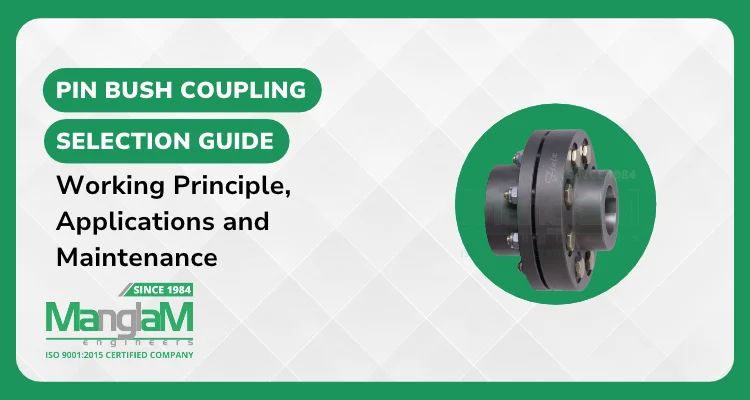
A pin bush coupling can fit both shafts and still be the wrong coupling for the drive. Startup torque, shock loads, speed, alignment and bush material all affect bush wear and the loads transmitted to the bearings.
This guide explains how pin bush couplings work, where they fit, how to size them and what to inspect during maintenance.
Key Takeaways
- Definition. A pin bush coupling joins two shafts using steel pins that transmit torque through flexible rubber or polyurethane bushes.
- Torque Path. Torque flows from the driver flange through the pins into the bushes and on to the driven flange, so the bushes absorb shock and damp vibration.
- Misalignment Is Limited. Allowable angular and parallel misalignment and axial movement depend on the model and operating conditions.
- Select on Design Torque. Use power and RPM at the coupling location. Apply the manufacturer’s service-factor method and check peak loads where specified.
- Check the Fit and Speed. Confirm maximum operating speed, bore range, keyway, distance between shaft ends (DBSE) and hub-face gap.
- Choose the Bush Grade. Verify torque capacity, damping, fluid compatibility and temperature limits for the grade.
- Maintain by Inspection. The Finix coupling needs no routine lubrication. Inspect the bushes, pins and retaining hardware.
- Send Complete Data. Include the drive loads, shaft dimensions, duty and operating environment for final selection.
What Is a Pin Bush Coupling?
A pin bush coupling is a flexible shaft coupling with two flanges joined by steel pins. Each pin carries a flexible bush, made of rubber or polyurethane, that sits in a matching hole in the opposite flange. The bushes deform under load and can reduce the shock and torsional vibration transmitted through the drive.
Manglam Engineers manufactures the Finix Pin Bush Type Coupling in Ahmedabad. The design uses steel bolts and either rubber or polyurethane bushes.
How Does a Pin Bush Coupling Work?
Torque moves through the coupling in three steps: the driver flange turns, its pins push against the bushes, and the bushes push the driven flange. Because the bush compresses slightly under load, it softens startup shock, damps torsional vibration and lets the two flanges sit with a small offset.
Excess shaft misalignment increases cyclic loading on the bushes and can accelerate wear. Align the machine to the equipment maker’s installation targets and confirm that the selected coupling can accommodate the expected operating movement, including thermal growth or shaft end float.
Manglam’s Finix design needs no routine lubrication and allows bush inspection and replacement without moving the connected machines, provided the installation leaves enough access to withdraw the pins and bushes.
Where Is It Used?
Typical duties include centrifugal pumps, motor-to-gearbox drives, conveyors, fans and mixers. A pin bush coupling can also suit high-torque duties when the selected model is rated for the load and speed. For drive layouts that include a gearbox, see the guide to choosing a coupling for motors and gearboxes.
For compact drives or positioning duties, compare the available installation space and allowable backlash against the exact model.
Would a Pin Bush Coupling Suit Your Drive?
Tell Manglam Engineers what the coupling connects, how often the drive starts and whether it sees shock or reversing loads. The team can help you narrow down a suitable coupling type.
Discuss Your Coupling Requirement →How Do You Select a Pin Bush Coupling?
Use design torque to shortlist sizes, then verify the transient loads, operating speed, shaft fit and available space.
- Collect the drive data. Record transmitted power and RPM at the coupling, both shaft diameters, keyway sizes and the driven machine. For a coupling on a gearbox output, use the output shaft speed and power at that location.
- Calculate running torque. Torque (N·m) ≈ 9,550 × power (kW) ÷ speed (RPM).
- Apply the manufacturer’s selection method. Where specified, multiply running torque by the service factor for the duty. Check startup, braking, reversing and other known transient loads against the applicable peak or cyclic torque limits. Apply each load allowance once.
- Match the size. Check that the selected bush grade and coupling size meet the design torque and cover the highest operating speed. Verify the permissible bore and keyway for each hub.
- Check DBSE, hub-face gap and access. Verify the distance between shaft ends and the specified gap between the hub faces. Allow enough room to fit and withdraw the pins and bushes.
- Choose the bush material. Confirm the grade for the load, operating temperature, damping requirements and exposure to fluids or chemicals.
- Confirm against the current datasheet and drawing. Ask Manglam Engineers for the exact model’s ratings, permissible shaft movement, bore and mounting dimensions before ordering.
- Worked example. A coupling transmitting 11 kW at 1,440 RPM carries about 73 N·m of running torque. An illustrative service factor of 1.5 gives about 109 N·m of design torque. Use the applicable manufacturer method for an actual drive. See how to select a coupling based on torque and RPM for the calculation and transient load checks.
Rubber or Polyurethane Bushes?
Compare the specific rubber and polyurethane grades available for your model. Hardness, formulation and bush geometry all influence the way the coupling responds under load.
| Factor | What to Compare for Either Material |
| Damping and stiffness | Check the grade’s torsional stiffness and damping for the drive’s shock and vibration levels. |
| Load capacity | Use the rating for that bush grade and coupling size, including any temperature derating. |
| Oil and abrasion exposure | Identify the actual oil or chemical, the type of exposure and any abrasive contamination. |
| Temperature and aging | Confirm the operating temperature range and expected exposure to heat, ozone or weather. |
Manglam also offers industrial rubber bushes. For a replacement, confirm the coupling model, bush dimensions and grade before ordering.
Common Selection Mistakes
- Sizing by bore only. The hub fits, but startup torque exceeds the rating.
- Ignoring peak torque. Frequent starts, reversing and shock loads can exceed the selected model’s transient load limits.
- Overlooking service clearance. A coupling can fit between the shaft ends and still leave too little room to remove pins and bushes.
- Mixing bush types. Old and new, or hard and soft, bushes load unevenly.
- Using the coupling to fix misalignment. This shortens bush life and stresses bearings.
Need a Finix Pin Bush Coupling Sized for Your Drive?
Send the transmitted power and RPM at the coupling, both shaft diameters, keyway sizes, DBSE and any known peak loads. Ask Manglam Engineers to confirm the model and bush grade against your duty.
Request a Free Quote →Pin Bush Coupling vs Jaw Coupling vs Tyre Coupling
Compare the models for torque, speed, allowable shaft movement and maintenance access. If a pump layout requires a specified DBSE and space to withdraw the spacer, also consider an RRL spacer coupling.
| Coupling | How It Works | Typical Applications | Maintenance | Key Risk |
| Pin bush | Steel pins transmit torque through bushes | Pumps, conveyors, fans | In-place bush replacement on Finix, with clearance | Bush wear if misaligned |
| Jaw | Elastomer spider between two hubs | Compact motor-pump drives | Replace spider | Wrong spider material |
| Tyre | Flexible tyre between flanges | Shock loads and greater movement where rated | Replace tyre | Larger space needed |
How Do You Install a Pin Bush Coupling Correctly?
Follow the instructions for the specific coupling and connected equipment. Check the hub gap and alignment before commissioning.
- Isolate the drive. Follow the site’s lockout/tagout procedure, control stored energy and verify isolation before removing the guard or working on the coupling.
- Prepare the shafts. Clean them, check the keys and keyways, and mount and secure each hub as specified in the model instructions.
- Set the hub-face gap. Use the model drawing for hub position and face gap. Check that the installed shaft spacing matches the specified DBSE.
- Check for soft foot. Make sure machine feet sit flat before aligning.
- Align the shafts. Use a dial indicator or laser tool and the equipment maker’s alignment targets. Verify acceptable axial travel and any required cold alignment offset for thermal growth.
- Fit bushes and pins. Seat the bushes fully and tighten the retaining fasteners to the torque specified for the model.
- Refit the guard before startup. Check clearances while the drive is isolated. Follow the manufacturer’s commissioning and initial recheck instructions.
How Do You Maintain a Pin Bush Coupling?
Set the inspection interval using Manglam’s guidance, duty and environment. Inspect during planned shutdowns with the drive isolated. Check the bushes, pins, retainers and flange holes for wear or damage.
Look for these warning signs:
- Rubber dust or powder around the coupling guard
- Cracks, hardening or swelling on the bush surface
- Ovality or wear in the pin holes
- Loose pin nuts or visible pin movement
| Symptom | Possible Cause | What to Check |
| Knocking at startup | Worn bushes or backlash | Bush condition, pin fit and measured backlash |
| Rising vibration | Misalignment or uneven bush wear | Alignment and soft foot |
| Rubber dust | Excess offset or overload | Alignment, loads and contamination |
| Hardened or cracked bushes | Heat, ozone or chemical attack | Environment and bush material |
| Hub heating | Poor alignment or friction | Gap, alignment, pin tightness |
Use these symptoms to guide the inspection. If the bushes reach the manufacturer’s wear limit or show damage that requires replacement, fit a matched set of the specified grade. Assess worn pins or oval flange holes separately. For repeated failures, review load, alignment, temperature and contamination before returning the drive to service.
Why Manglam Engineers for Pin Bush Couplings?
Manglam Engineers is an Ahmedabad-based manufacturer of mechanical power transmission couplings and industrial rubber parts, with 40+ years of experience as stated on its website and ISO 9001:2015 certification. Its coupling range includes pin bush, jaw, tyre and spacer options for different drive layouts.
Manglam also reviews custom requirements for applications with specific fit or service needs. Overseas buyers can review the export page for current market information.
Conclusion
For a reliable fit, confirm torque and speed at the coupling, verify the hub dimensions and select the bush grade for the duty. Correct alignment and regular inspection help limit bush wear.
Need Replacement Bushes for an Existing Coupling?
Share the existing coupling model, photos of the wear and the duty conditions. Manglam Engineers can help identify the matching bush set and flag fit or alignment checks for repeat failures.
Discuss Your Replacement Requirements →FAQs
What Is a Pin Bush Coupling Used For?
A pin bush coupling connects the driving and driven shafts and helps damp torsional vibration and cushion shock loads. Common applications include pumps, conveyors, fans and gearbox drives.
How Do You Select a Pin Bush Coupling?
Use power and RPM at the coupling to calculate running torque. Apply the manufacturer’s selection method, check peak loads where specified and confirm maximum speed, shaft fit, DBSE and bush grade from the model data.
Does a Pin Bush Coupling Need Lubrication?
The Finix Pin Bush Type Coupling needs no routine lubrication. Inspect the bushes, pins and retaining hardware at the recommended intervals.
How Often Should Pin Bush Coupling Bushes Be Replaced?
Bush life depends on torque, alignment, temperature and environment. Follow the model’s inspection guidance, check any sign of damage or wear against the replacement criteria, and use a matched set when replacement is due.
Can a Pin Bush Coupling Correct Shaft Misalignment?
A pin bush coupling can accommodate limited angular and parallel misalignment and axial movement. Set machine alignment to the equipment maker’s targets and check the selected model’s operating limits.
What Information Does Manglam Need to Quote a Pin Bush Coupling?
Send power and RPM at the coupling, both shaft diameters and keyways, DBSE, duty, known peak loads, operating conditions and any existing model or drawing. Include access constraints for maintenance.